WOW! SH sent $50, JC sent $5 and KW sent $40. Thanks to all of you!
March 25, 2007
Glorious Fat Cow in the Evening Light
Esmerelda, our Friesian cow, is growing incredibly large. I’m beginning to wonder if the Ambler’s calf, growing inside her, is going to spring forth fully formed!? We don’t think Esmerelda is due to calve until July, so how much bigger will she get?
I was out the other day, inspecting the boundary fences, and I snapped some images of our glorious (and strident) beast in the evening light.
In photography school, I learned how to use the evening sky as a massive softbox. Just wait for the sun to go below the horizon in the evening and you’ll have several minutes of warm light that flatters most subjects. Glossy car brochure photos are the most common examples of this technique. Let’s see how well it works on a cow the size of a minivan.

I’m ready for my closeup

Will that lens make me look fat?
March 24, 2007
Fabulous Pets in Our Kitchen
Finally we have some more livestock here on the Farmlet. These are not cows or goats, but colonies of bacteria and yeasts. They live in the kitchen, and I like to call them our “pets.”
We now have starters for kombucha, water kefir, kefir, and Caspian Sea yogurt. My sister and her partner were kind enough to transport them here for us when they traveled up from Wellington. They must have transported the pets with great care, as all arrived in good shape. They have settled well into their new home!
Here’s an introduction to the new pets, along with links for those who are curious:
For those who don’t know about kombucha, it’s a colony of yeasts and bacteria that form a slimy pancake-like mass known as a “scoby,” a “mother,” or a “mushroom.” The scoby will transform a container of sweet tea into a delicious sweet and sour beverage, which reputedly has great health-giving properties. The colony produces a new scoby with each batch, so you soon get plenty to give away to friends. My Dad took one look at the scoby and declared he’d be a bit concerned if he found one of those in his fridge. It certainly looks pretty dodgy!
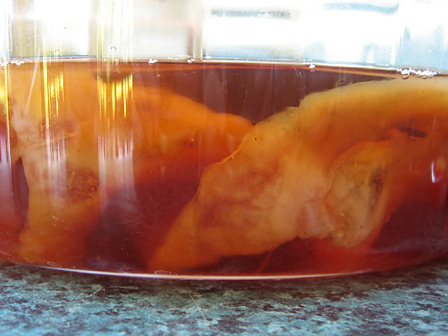
Kombucha
Water kefir are clear crystal-like grains that will culture sugar water (with other ingredients added) into a fizzy, refreshing beverage. We’ve been adding lemon, raisins, and various herbs from the garden.

Water kefir
Kefir (milk kefir) are opaque grains that will culture milk at room temperature. We have been using the resulting kefir to make smoothies. I’m also keen to try making some kefir cheese.
And what about Caspian Sea Yogurt? It is a special yogurt that cultures at room temperature. Instead of heating the milk and keeping it at above room temperature to culture, this culture can just be stirred into raw milk at room temperature and left to thicken. It takes about 8-12 hours. The resulting yogurt is mild and creamy, with a stringier texture than regular yogurt. It’s really easy to make, and Kevin and I find it extremely tasty. Until a couple of weeks ago, I never knew there was such an easy way to make raw milk yogurt.
We are having a lot of fun playing around with all these new livestock. If any readers live nearby and would like to have some starters, please let us know. We’d be delighted to share.
March 17, 2007
Farmlet Reader Contributes AUD$20
Farmlet reader and repeat contributor, IL, sent AUD$20! Thanks IL!
Comments Off on Farmlet Reader Contributes AUD$20
March 16, 2007
Tomato Adventure
Finally, here is the update on my tomato preserving adventures. As a novice preserver, I’m pleased (relieved, even) to report that the tomato canning exercise seems to have been a success. Special thanks are due to Mum and Auntie Linda and that trusty Kiwi classic, the Edmond’s Cookery Book!

Preserved tomatoes
To date, I have canned seven quarts of tomato puree in glass preserving jars with dome seals, using the “overflow method.” These 7 jars are the result of boiling down some 14 kilos of tomatoes.
This is what I did:
*Cut up the tomatoes with skins still on, and made a puree using a stick blender.
*Filled a large stock pot with the puree, and simmered it for a couple of hours to reduce.
*Added a little salt.
*Heated the preserving jars in a 120 degrees celsius oven for 30 minutes.
*Put the seals in boiling water for 5 minutes.
*Took hot jars out of the oven one at a time to be filled with hot puree and sealed.
*Added 1/2t of citric acid to each jar to ensure sufficient acidity to inhibit growth of bacteria.
*Filled each jar to the very top (almost overflowing).
*Placed hot seal on top of jar, using tongs.
*Wiped off any excess juice, and fixed the seal in place with a screw band.
*Checked the jars after 12 hours of cooling to see if they had sealed properly.
*Removed screw bands and labelled the jars.
I’m sure we will value the taste that the tomatoes will add to our winter fare. Since sun drying (and even storing dehydrated products) can be problematic here due to the high humidity, and freezing uses so much energy, canning some puree seems like a good way for us to preserve our tomatoes. Fortunately, canned tomatoes do not require added sugar for successful preservation. We opted not to add other ingredients to the puree, in order to keep it as simple and versatile as possible.
There is so much going on here at the moment, and lots of posts I’d like to write for the Farmlet website. My brother and sister were visiting here for about ten days, so we took lots of time out to have fun with the family. We had a wonderful time, and I miss my brother and sister now that they are gone. Still, it’s good to be getting back to the regular work schedule around the Farmlet — not to mention a more regular blogging schedule!